This topic covers biological molecules, DNA and protein synthesis, inheritance, cells and membrane transport, cell division, and disease-causing microbes. Practice the short calculations until they feel automatic.
Biological molecules
- The four classes are carbohydrates, lipids, proteins and nucleic acids.
- Dehydration synthesis links two monomers and gives off one water molecule; hydrolysis uses water to break that link.
- Polysaccharides: starch (plant storage), glycogen (animal storage), cellulose (plant cell walls); sucrose is a disaccharide (glucose + fructose) and glucose a monosaccharide.
- Saturated fatty acids have only single carbon–carbon bonds; unsaturated ones have one or more double bonds, and cis double bonds bend the chain so it packs loosely and melts at a lower temperature, which is why olive oil, rich in cis oleic acid, is liquid at room temperature.
- Steroids such as cholesterol have four fused carbon rings; phospholipids build cell membranes.
- Proteins are amino acids joined by peptide bonds: primary structure is the sequence, secondary the hydrogen-bonded helices and sheets, tertiary the 3-D fold, quaternary several chains together.
- Heat or a pH change denatures a protein: its shape and function are lost, but the amino acid sequence stays.
- Nucleotides (sugar + phosphate + nitrogenous base) are the monomers of DNA and RNA.
DNA structure and replication
- DNA has deoxyribose, the bases A, T, G and C, and two strands in a double helix; RNA has ribose, the bases A, U, G and C, and is usually single-stranded.
- A always pairs with T, and G with C, so in double-stranded DNA the amount of A equals T and G equals C.
- The strands are antiparallel (the 5′ end of one faces the 3′ end of the other), and replication is semiconservative: each new helix has one old and one new strand.
- Helicase unwinds, primase adds RNA primers, DNA polymerase builds only 5′ → 3′ (so the lagging strand is made in short Okazaki fragments), and ligase seals the gaps.
Example
A sample of double-stranded DNA is 22% thymine. What percentage is cytosine?
Solution
A = T, so adenine is also 22% and A + T = 44%. G + C = 100% − 44% = 56%. G = C, so cytosine = 56% ÷ 2 = 28%.
From gene to protein
- Transcription copies DNA into mRNA; translation at the ribosome turns the mRNA message into protein.
- mRNA is complementary to the DNA template strand and is built 5′ → 3′, with U in place of T.
- A codon is three bases; AUG codes for methionine and is the start codon, while stop codons code for no amino acid.
- tRNA brings one specific amino acid and pairs its anticodon with the matching mRNA codon; rRNA plus proteins form the ribosome.
- Amino acids in a coding region = (nucleotides ÷ 3) − 1, because the stop codon adds none.
Example
A DNA template strand reads 3′-TACCGGATG-5′. What is the mRNA, and how many codons does it contain?
Solution
Pair each base: T→A, A→U, C→G, G→C. The template's 3′ end lines up with the mRNA's 5′ end, so the mRNA is 5′-AUGGCCUAC-3′. 9 nucleotides ÷ 3 = 3 codons.
Inheritance and Punnett squares
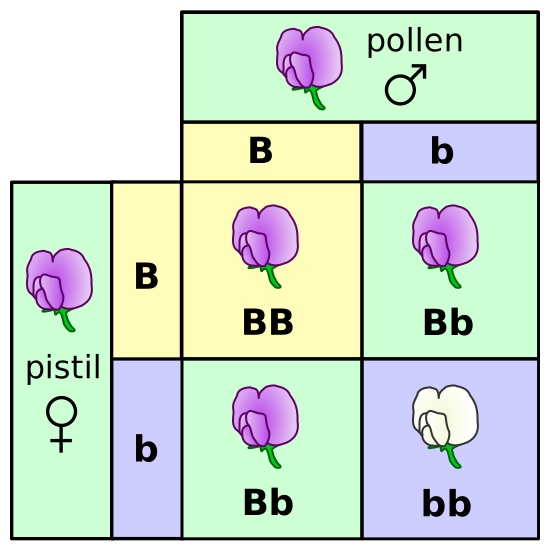
- Alleles are versions of a gene: homozygous means two identical alleles (TT or tt), heterozygous two different (Tt).
- Genotype is the allele pair; phenotype is the visible trait, and a recessive trait shows only in a homozygous recessive individual.
- Each parent passes one allele per gene with equal chance (segregation), and genes for different traits sort into gametes separately (independent assortment).
- Tt × Tt gives genotypes 1 TT : 2 Tt : 1 tt and phenotypes 3 dominant : 1 recessive.
- A test cross pairs a dominant-looking individual with a homozygous recessive; about half recessive offspring means the parent was heterozygous.
- For independent genes, multiply the probabilities; AaBb × AaBb gives a 9:3:3:1 phenotype ratio.
- Incomplete dominance makes the heterozygote intermediate: red × white snapdragons give pink, and pink × pink gives 1 red : 2 pink : 1 white.
- X-linked recessive traits such as hemophilia: a son's only X comes from his mother, so a carrier mother passes the trait to about half her sons.
Example
Genes A and B assort independently. In the cross AaBb × Aabb, what is the probability of an aabb offspring?
Solution
Aa × Aa gives aa with probability 1/4. Bb × bb gives bb with probability 1/2. Multiply: 1/4 × 1/2 = 1/8.
Cells and membrane transport
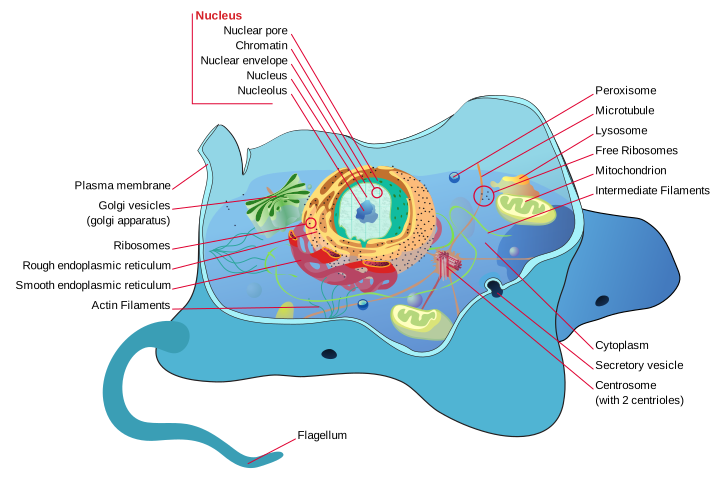
- Every cell has a plasma membrane, cytoplasm, DNA and ribosomes; prokaryotic cells are far smaller and have no nucleus or other membrane-bound organelles.
- Mitochondria make ATP, ribosomes make proteins, lysosomes break down worn-out parts, smooth ER makes lipids, and the Golgi modifies, sorts and packages.
- Secreted proteins go rough ER → transport vesicle → Golgi → secretory vesicle → plasma membrane, so protein-secreting cells such as plasma cells are packed with rough ER.
- Plant cells add chloroplasts, a cellulose cell wall and a large central vacuole.
- Diffusion and facilitated diffusion (through channel or carrier proteins, as for glucose) move substances from high to low concentration without energy.
- Osmosis: in a hypotonic solution a red blood cell gains water, swells and may burst; in a hypertonic one it shrinks; in an isotonic one there is no net change.
- Active transport spends ATP to move substances against their gradient; the sodium–potassium pump moves 3 Na⁺ out and 2 K⁺ in.
Mitosis and meiosis
- Human body cells are diploid, with 46 chromosomes in two matched (homologous) sets of 23, one set from each parent; haploid gametes have 23.
- Interphase: G1 (growth), S (DNA replication, making sister chromatids joined at the centromere), G2 (preparation).
- Mitosis: prophase (chromosomes condense, spindle forms, nuclear envelope breaks up) → metaphase (line up at the center) → anaphase (sister chromatids separate) → telophase (nuclei re-form); cytokinesis then gives two identical diploid cells.
- Meiosis I: homologs pair and cross over in prophase I, then separate; meiosis II: sister chromatids separate, giving four genetically unique haploid cells.
Example
A cell with 2n = 12 goes through meiosis. How many cells and chromosomes result after meiosis I and after meiosis II?
Solution
Meiosis I separates homologs: 2 cells with 6 chromosomes each. Meiosis II separates sister chromatids: 4 haploid cells with 6 chromosomes each.
Microorganisms and disease
- Bacteria are prokaryotic cells with ribosomes that reproduce by binary fission; antibiotics treat bacterial infections but are useless against viruses.
- Viruses are not cells: a DNA or RNA genome in a protein capsid, with no ribosomes, many of them 20–300 nanometers across; they replicate only inside a host cell.
- HIV, a retrovirus, uses reverse transcriptase to copy its RNA into DNA that joins the host genome; drugs such as zidovudine block this step.
- Fungi (yeasts and molds) are eukaryotes with chitin cell walls; they cause athlete's foot and thrush, they can be hard to kill, and some antifungal drugs also act on human cells.
- Protists are the eukaryotes left over once animals, plants and fungi are set aside; the protist Plasmodium, carried by Anopheles mosquitoes, causes malaria.
Key terms
- Dehydration synthesis
- A reaction that joins two monomers and releases one water molecule.
- Hydrolysis
- A reaction that splits a polymer by adding water across a bond.
- Polysaccharide
- A long chain of sugar units, such as starch, glycogen or cellulose.
- Unsaturated fatty acid
- A fatty acid chain with one or more carbon–carbon double bonds.
- Denaturation
- Loss of a protein's shape and function from heat, pH or chemicals, with its sequence unchanged.
- Nucleotide
- A sugar, a phosphate group and a nitrogenous base; the monomer of DNA and RNA.
- Semiconservative replication
- DNA copying in which each new double helix keeps one old strand and gains one new strand.
- Codon
- A three-base mRNA sequence that specifies one amino acid or a stop signal.
- Anticodon
- The three tRNA bases that pair with a matching mRNA codon.
- Allele
- One version of a gene.
- Heterozygous
- Having two different alleles for a gene, such as Tt.
- Phenotype
- The observable trait an organism shows, as opposed to its alleles.
- Incomplete dominance
- Inheritance in which the heterozygote looks intermediate, such as pink flowers from red and white parents.
- Hypotonic solution
- A solution with a lower solute concentration than the cell, so water moves in.
- Active transport
- Movement of a substance against its concentration gradient using energy, usually ATP.
- Sister chromatids
- The two identical copies of a replicated chromosome, joined at the centromere.
- Meiosis
- Two divisions that turn one diploid cell into four genetically different haploid cells.
- Reverse transcriptase
- Retroviral enzyme that builds DNA from an RNA template.
Common mistakes
- Mixing up the two Punnett ratios. Tt × Tt gives 1:2:1 for genotypes (TT:Tt:tt) but 3:1 for phenotypes, because TT and Tt look the same.
- Miscounting amino acids. AUG at the start codes for methionine and counts, but the stop codon codes for nothing and does not count.
- Writing mRNA with thymine or backward. RNA uses U, and the mRNA's 5′ end pairs with the template's 3′ end.
- Reversing tonicity. A hypotonic solution (fewer solutes outside) makes a cell swell; a hypertonic one makes it shrink.
- Confusing the divisions. Homologous chromosomes separate in meiosis I and sister chromatids in meiosis II; mitosis gives 2 identical diploid cells, meiosis 4 haploid cells.
- Treating viruses like bacteria. Viruses are not cells, have no ribosomes or cell wall, and are not killed by antibiotics.
Checked against: MedlinePlus, Antibiotics; Wikipedia, Biomolecule; Wikipedia, Hydrolysis; Wikipedia, Polysaccharide; Wikipedia, Sucrose; Wikipedia, Fatty acid; Wikipedia, Cis–trans isomerism; Wikipedia, Oleic acid; Wikipedia, Fat; Wikipedia, Steroid; Wikipedia, Phospholipid; Wikipedia, Protein structure; Wikipedia, Denaturation (biochemistry); Wikipedia, DNA; Wikipedia, RNA; Wikipedia, Chargaff's rules; Wikipedia, DNA replication; Wikipedia, Transcription (biology); Wikipedia, Genetic code; Wikipedia, Ribosome; Wikipedia, Mendelian inheritance; Wikipedia, Test cross; Wikipedia, Dominance (genetics); Wikipedia, X-linked recessive inheritance; Wikipedia, Prokaryote; Wikipedia, Cell (biology); Wikipedia, Endomembrane system; Wikipedia, Endoplasmic reticulum; Wikipedia, Golgi apparatus; Wikipedia, Plasma cell; Wikipedia, Vacuole; Wikipedia, Tonicity; Wikipedia, Facilitated diffusion; Wikipedia, Na+/K+-ATPase; Wikipedia, Ploidy; Wikipedia, Cell cycle; Wikipedia, Centromere; Wikipedia, Mitosis; Wikipedia, Meiosis; Wikipedia, Bacteria; Wikipedia, Virus; Wikipedia, Reverse transcriptase; Wikipedia, Fungus; Wikipedia, Antifungal; MedlinePlus, Fungal Infections; MedlinePlus, Thrush; Wikipedia, Protist; Wikipedia, Malaria