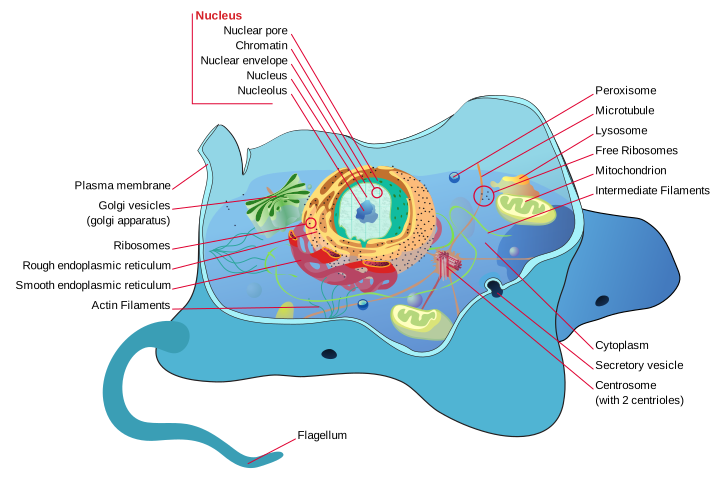
This topic covers cell types and organelles, how substances cross the membrane, the stages of cellular respiration and photosynthesis with where each happens and what it makes, and the steps of mitosis and meiosis. Track location, inputs and outputs for every process, and keep chromosome counts straight in cell division.
Prokaryotic and eukaryotic cells
- All cells share four features: a plasma membrane, cytoplasm, DNA and ribosomes.
- Prokaryotes (bacteria and archaea) lack a nucleus; their DNA sits in an unenclosed area known as the nucleoid, and most have a cell wall outside the membrane.
- Eukaryotes (animals, plants, fungi and protists) keep their DNA in a membrane-bound nucleus and also have other membrane-bound organelles.
- Most prokaryotes measure between 0.1 and 5.0 µm across, while eukaryotic cells are often 2 to 100 times as wide.
- When a cell gets bigger, its volume grows faster than its surface area, so the surface area per unit of volume drops and the membrane serves the cell less efficiently; this is one reason cells stay small.
Example
Cell A is a cube 2 µm on a side and cell B is a cube 6 µm on a side. Compare their surface area-to-volume ratios.
Solution
A: surface area = 6 × 2² = 24 µm², volume = 2³ = 8 µm³, ratio = 24 ÷ 8 = 3. B: surface area = 6 × 6² = 216 µm², volume = 6³ = 216 µm³, ratio = 216 ÷ 216 = 1. B's ratio is one-third of A's (for a cube the ratio is 6 ÷ side length).
Organelles and their jobs
- Nucleus: stores the DNA; the nucleolus within it assembles ribosome subunits.
- Ribosomes: build proteins; they are not wrapped in a membrane of their own and occur in all cells.
- Rough ER: dotted with ribosomes; helps new proteins fold and modifies them.
- Smooth ER: no ribosomes; makes lipids and steroid hormones, detoxifies drugs and alcohol, and stores calcium ions (in muscle, as the sarcoplasmic reticulum).
- Golgi apparatus: modifies proteins and lipids, then sorts and packages them into vesicles for shipping.
- Lysosomes: membrane sacs of hydrolytic (digestive) enzymes that break down engulfed bacteria and worn-out organelles.
- Peroxisomes: break down fatty acids and detoxify harmful substances such as hydrogen peroxide and alcohol.
- Mitochondria: produce most of the cell's ATP through aerobic respiration and carry their own DNA.
- Plant cells add a cellulose cell wall, chloroplasts and a large central vacuole; animal cells have centrioles and lysosomes, which most plant cells lack.
- Plant cells and animal cells both contain mitochondria.
Moving substances across the membrane
- Passive transport carries substances from higher to lower concentration and spends no ATP.
- Simple diffusion: small nonpolar molecules such as O₂ and CO₂ slip directly through the lipid bilayer.
- Facilitated diffusion: ions and polar molecules cross through channel or carrier proteins, yet still travel only down their gradient.
- Osmosis: water diffuses across a membrane toward the side holding more solute.
- Hypotonic solution (less solute outside): water moves in, red blood cells may swell and burst, and plant cells become firm (turgid).
- Hypertonic solution (more solute outside): water moves out, red blood cells shrink, and a plant cell's membrane pulls away from its wall (plasmolysis).
- Isotonic solution: water moves in and out equally, so there is no net change.
- Active transport pushes a substance against its gradient (low to high) and needs energy, usually from ATP.
- For each ATP it uses, the sodium-potassium pump moves 3 Na⁺ out of the cell and 2 K⁺ in.
Cellular respiration: glycolysis and the citric acid cycle
Overall: C₆H₁₂O₆ + 6O₂ → 6CO₂ + 6H₂O + energy (ATP). It is a catabolic process.
- Glycolysis takes place in the cytoplasm, runs with or without oxygen, and is widespread among living things.
- Glycolysis breaks one glucose into 2 pyruvate; it uses 2 ATP and makes 4, a net gain of 2 ATP, plus 2 NADH.
- In the mitochondrial matrix, each pyruvate loses 1 CO₂ and becomes acetyl CoA, also forming 1 NADH.
- One turn of the citric acid (Krebs) cycle gives off 2 CO₂ and yields 3 NADH, 1 FADH₂ and 1 ATP (or GTP).
- The cycle runs twice for each glucose: 4 CO₂, 6 NADH, 2 FADH₂ and 2 ATP in total.
Electron transport chain and fermentation
- NADH and FADH₂ hand their electrons to the chain of carrier proteins (the electron transport chain) in the inner mitochondrial membrane.
- The electrons' energy pumps H⁺ from the matrix across into the intermembrane space.
- H⁺ returns to the matrix through ATP synthase, and that flow drives the joining of ADP and phosphate into ATP (chemiosmosis).
- Oxidative phosphorylation makes most of the ATP from aerobic glucose breakdown, far more than glycolysis's 2.
- Oxygen is the final electron acceptor: it picks up the electrons and joins with H⁺ to form water.
- With no oxygen the chain halts, and cells turn to fermentation, which turns NADH back into NAD⁺ so glycolysis can keep making its 2 ATP.
- Lactic acid fermentation (in muscle short of oxygen) converts pyruvate to lactate and gives off no CO₂.
- Alcohol fermentation (in yeast) converts pyruvate to ethanol and CO₂.
Photosynthesis
Overall: 6CO₂ + 6H₂O + light energy → C₆H₁₂O₆ + 6O₂. It takes place in chloroplasts.
- The light-dependent reactions take place in the thylakoid membranes, where chlorophyll absorbs mostly red and blue light.
- Photosystem II makes up for the electrons it loses by splitting water, so the O₂ a plant gives off comes from water.
- The light reactions produce ATP and NADPH, using an H⁺ gradient and ATP synthase in much the same way mitochondria do.
- The Calvin cycle (light-independent reactions) takes place in the stroma, the fluid surrounding the thylakoids.
- The enzyme RuBisCO attaches CO₂ to RuBP, and the cycle spends ATP and NADPH from the light reactions to build the sugar G3P.
- The Calvin cycle must turn 6 times, fixing 6 CO₂, to build one glucose.
- CO₂ enters the leaf, and water vapor leaves it, through pores called stomata.
Cell cycle and mitosis
- Human body cells are diploid, with 46 chromosomes (23 pairs); gametes are haploid, with 23.
- Interphase: G1 (the cell grows), S (DNA is copied, giving two sister chromatids held at a centromere) and G2 (the cell gets ready for mitosis).
- Prophase (with prometaphase): chromosomes condense, the spindle forms and the nuclear envelope breaks apart.
- Metaphase: chromosomes line up in a single row across the cell's middle (the metaphase plate).
- Anaphase: sister chromatids pull apart and head to opposite poles.
- Telophase: each set of chromosomes gets its own nuclear envelope, and the chromosomes loosen.
- Cytokinesis divides the cytoplasm, by a cleavage furrow in animal cells and a cell plate in plant cells.
- Mitosis with cytokinesis yields two diploid daughter cells identical to the parent, used for growth and replacing cells.
Meiosis
- Meiosis copies the DNA once and then divides twice, producing four haploid, genetically different cells (gametes).
- Prophase I: homologous chromosomes pair up, and non-sister chromatids swap segments (crossing over), creating new allele combinations.
- Metaphase I: homologous pairs line up in random orientation (independent assortment).
- Anaphase I: homologous chromosomes move apart, while sister chromatids remain attached.
- After meiosis I, each human cell holds 23 chromosomes, each still made of two sister chromatids.
- Meiosis II resembles mitosis: sister chromatids split, leaving 23 single-chromatid chromosomes in each of four cells.
Key terms
- Prokaryote
- Cell without a nucleus or membrane-bound organelles, such as a bacterium.
- Smooth endoplasmic reticulum
- Ribosome-free membrane network that makes lipids and steroids, detoxifies drugs and stores calcium.
- Lysosome
- Membrane sac of hydrolytic enzymes that digests engulfed material and worn-out organelles.
- Mitochondrion
- Organelle that makes most ATP by aerobic respiration; has its own DNA.
- Osmosis
- Diffusion of water across a selectively permeable membrane toward higher solute concentration.
- Hypertonic
- Describes a solution with more solute than the cell, so water leaves the cell.
- Active transport
- Movement of a substance against its concentration gradient using energy, usually ATP.
- Glycolysis
- Splitting of glucose into 2 pyruvate in the cytoplasm, net 2 ATP and 2 NADH.
- Citric acid cycle
- Matrix pathway that oxidizes acetyl CoA, releasing CO₂ and loading NADH and FADH₂.
- Chemiosmosis
- ATP production driven by H⁺ flowing down its gradient through ATP synthase.
- Final electron acceptor
- Oxygen in aerobic respiration; it takes electrons at the chain's end and forms water.
- Fermentation
- Anaerobic pathway that regenerates NAD⁺ from NADH so glycolysis can continue.
- Thylakoid
- Membrane disc in a chloroplast where the light-dependent reactions occur.
- Calvin cycle
- Stroma reactions that use ATP and NADPH to turn CO₂ into sugar.
- S phase
- Part of interphase in which DNA is replicated.
- Metaphase
- Mitotic stage when chromosomes line up across the middle of the cell.
- Crossing over
- Exchange of segments between non-sister chromatids of homologous chromosomes in prophase I.
- Haploid
- Having one set of chromosomes (n), as in gametes; 23 in humans.
- Diploid
- Having two sets of chromosomes (2n), one from each parent; 46 in human body cells.
Common mistakes
- Ribosomes, a plasma membrane and DNA are found in every cell; what sets eukaryotes apart from prokaryotes is a membrane-bound nucleus and other membrane-bound organelles. Plant cells have mitochondria too.
- Lysosomes digest engulfed material; the Golgi packages, peroxisomes break down fatty acids, and the smooth ER (not the rough ER) makes steroid hormones and stores calcium.
- Facilitated diffusion and osmosis are passive and move only down a gradient; only active transport moves substances from low to high concentration. In a hypertonic solution, water leaves the cell.
- Glycolysis makes 4 ATP but spends 2 (net 2) in the cytoplasm; count the citric acid cycle twice per glucose, and do not add in the NADH and CO₂ from pyruvate oxidation.
- Oxygen, not NAD⁺ or CO₂, is the final electron acceptor; ATP synthase is powered by H⁺ flow, and lactate fermentation makes no extra ATP and no CO₂.
- The light reactions (thylakoids) make ATP and NADPH and release O₂ from water; the Calvin cycle (stroma) uses them. Crossing over happens in prophase I between non-sister chromatids, and after meiosis I a human cell has 23 two-chromatid chromosomes.
Checked against: Wikipedia, Cell (biology); Wikipedia, Prokaryote; Wikipedia, Eukaryote; Wikipedia, Surface-area-to-volume ratio; Wikipedia, Nucleolus; Wikipedia, Ribosome; Wikipedia, Endoplasmic reticulum; Wikipedia, Golgi apparatus; Wikipedia, Lysosome; Wikipedia, Peroxisome; Wikipedia, Mitochondrion; Wikipedia, Plant cell; Wikipedia, Passive transport; Wikipedia, Tonicity; Wikipedia, Active transport; Wikipedia, Sodium–potassium pump; Wikipedia, Cellular respiration; Wikipedia, Glycolysis; Wikipedia, Citric acid cycle; Wikipedia, Oxidative phosphorylation; Wikipedia, Chemiosmosis; Wikipedia, Fermentation; Wikipedia, Photosynthesis; Wikipedia, Calvin cycle; Wikipedia, Stoma; Wikipedia, Cell cycle; Wikipedia, Mitosis; Wikipedia, Meiosis; Wikipedia, Ploidy