This topic covers DNA structure and base pairing, how DNA is copied, how genes are transcribed and translated into protein, how mutations change proteins, and Mendelian inheritance with Punnett squares. Base-pairing and Punnett-square questions are worked problems, so practice writing them out step by step.
DNA structure
- DNA forms a double helix, with the paired bases tucked between the strands and the sugar-phosphate backbones running along the outside.
- Within one strand, neighboring nucleotides are joined by phosphodiester bonds.
- Hydrogen bonds between bases hold the two strands together: two in each A–T pair and three in each G–C pair.
- A always pairs with T and G with C, so A = T and G = C in double-stranded DNA (Chargaff's rules).
- The two strands are antiparallel: one runs 5′ to 3′ and its partner runs 3′ to 5′.
- RNA uses ribose and has uracil (U) in place of thymine, so in RNA A pairs with U.
Example
(1) In a DNA sample, 22% of the bases are adenine. What percentage are cytosine? (2) Write the strand complementary to 5′-GATTCA-3′, also 5′ to 3′.
Solution
(1) T = A = 22%, so A + T = 44% and G + C = 56%; since G = C, cytosine = 28%. (2) Pair each base: G→C, A→T, T→A, T→A, C→G, A→T gives 3′-CTAAGT-5′. Read it backward to write it 5′ to 3′: 5′-TGAATC-3′.
DNA replication
- Copying is semiconservative: every daughter molecule pairs one old strand with one freshly made strand, a model the Meselson-Stahl experiment supported.
- Helicase separates the two strands at the replication fork, snapping the base-pair hydrogen bonds as it moves along.
- DNA polymerase cannot start a strand from nothing, so primase first lays down a short RNA primer for it to extend.
- Polymerase only ever adds nucleotides to a 3′ end, so every new strand grows from its 5′ end toward its 3′ end.
- The leading strand is built in one continuous piece toward the fork; the lagging strand is built away from the fork as short Okazaki fragments, each started by its own primer.
- Later the RNA primers are swapped for DNA, and DNA ligase closes the remaining nicks by forming phosphodiester bonds.
Transcription and RNA processing
- In short (the central dogma): DNA is transcribed into mRNA, which is then translated into protein.
- RNA polymerase attaches at a promoter, reads the template strand, and assembles a complementary mRNA, always adding to the mRNA's 3′ end.
- Eukaryotic cells transcribe and process mRNA inside the nucleus, then translate it on ribosomes out in the cytoplasm.
- With no nucleus to separate them, prokaryotes can translate an mRNA while it is still being transcribed.
- Processing adds a 5′ cap and a poly-A tail; these guard the mRNA against breakdown, help it exit the nucleus and support translation.
- Splicing cuts out the noncoding introns and stitches the coding exons together.
Translation and the genetic code
- Each codon is three mRNA bases; of the 64 codons, 61 code for amino acids and 3 (UAA, UAG, UGA) are stop codons.
- AUG is the start codon and codes for methionine.
- The code is degenerate: most amino acids have more than one codon, but each codon means only one thing.
- Starting at the start codon, the message is read three bases at a time with no overlaps, and almost all living things use the same code.
- Each tRNA carries one amino acid, and its anticodon pairs antiparallel with the matching codon.
- The ribosome, built from rRNA and proteins, links amino acids with peptide bonds and halts when it reaches a stop codon.
Example
An mRNA codon reads 5′-AUG-3′. What is the tRNA anticodon, written 3′ to 5′?
Solution
Pair each base (A–U, G–C): A→U, U→A, G→C. Lined up antiparallel, the anticodon is 3′-UAC-5′.
Mutations and chromosome errors
- A substitution changes one base; it can be silent (same amino acid), missense (a different amino acid) or nonsense (a new stop codon that cuts the protein short).
- Inserting or deleting one or two bases shifts the reading frame (frameshift), so every codon after the change is misread.
- Inserting or deleting three bases adds or removes one codon and keeps the reading frame.
- Nondisjunction happens when homologous chromosomes (meiosis I) or sister chromatids (meiosis II) fail to pull apart.
- If a gamete carrying an extra chromosome 21 fuses with a normal one, the result is trisomy 21 (Down syndrome); the chance of this rises as the mother gets older.
Mendel's laws and vocabulary
- Genotype is the pair of alleles an organism carries (for example Pp); phenotype is the observable trait (purple flowers).
- Homozygous means two identical alleles (PP or pp); heterozygous means two different alleles (Pp).
- A dominant allele (capital letter) masks a recessive allele (lowercase) in a heterozygote; a recessive trait shows only when homozygous.
- Law of segregation: when gametes form, the two alleles of a gene part ways, so each gamete gets just one.
- Law of independent assortment: alleles for different traits are sorted into gametes without affecting each other, except when the genes are linked on one chromosome.
Punnett squares and test crosses
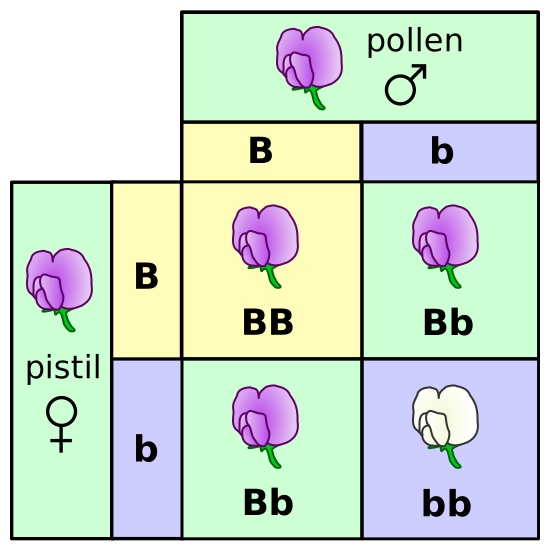
- Heterozygote × heterozygote (Bb × Bb) gives BB, Bb and bb in a 1 : 2 : 1 ratio, and dominant to recessive phenotypes in a 3 : 1 ratio.
- A test cross mates a dominant-looking individual with a homozygous recessive one: all dominant offspring means the parent is BB, and about half recessive means it is Bb.
- For two genes that assort independently, multiply the separate probabilities (product rule); AaBb × AaBb gives 9 : 3 : 3 : 1.
Example
Black fur (B) is dominant to brown (b). Cross Bb × Bb. What fraction of offspring are brown, and what fraction of the black offspring are heterozygous?
Solution
Gametes: B or b from each parent. Squares: BB, Bb, bB, bb, so one BB, two Bb and one bb. Brown (bb) = 1/4. Black offspring are BB, Bb and Bb (3 of 4 squares), and 2 of those 3 are Bb, so 2/3 of the black offspring are heterozygous.
Other inheritance patterns
- Incomplete dominance: the heterozygote is in between; red (RR) × white (WW) snapdragons give pink (RW), and pink × pink gives 1 red : 2 pink : 1 white.
- Codominance: both alleles show fully in the heterozygote, as in the MN blood group.
- Males have a single X (they are hemizygous), so one recessive X-linked allele is enough to show; that is why these traits appear more often in males.
- A son gets his only X from his mother; a daughter gets one X from each parent.
Example
(1) In peas, yellow (Y) is dominant to green (y) and round (R) to wrinkled (r). For YyRr × YyRr, what fraction are green and round? (2) In fruit flies, a carrier red-eyed female (XᵂXʷ) is crossed with a red-eyed male (XᵂY). What is expected?
Solution
(1) Green (yy) = 1/4 and round (R_) = 3/4, so 1/4 × 3/4 = 3/16. (2) Daughters get Xᵂ from the father, so all are red-eyed (half XᵂXᵂ, half carriers XᵂXʷ). Sons get their X from the mother, so half are XᵂY (red) and half are XʷY (white).
Key terms
- Complementary base pairing
- A bonds with T (or U in RNA) and G bonds with C.
- Antiparallel
- Running in opposite directions; one DNA strand goes 5′ to 3′, its partner 3′ to 5′.
- Semiconservative replication
- Copying in which each new double helix keeps one parental strand and gains one new strand.
- Helicase
- Enzyme that unwinds DNA by breaking hydrogen bonds between base pairs.
- DNA ligase
- Enzyme that seals gaps between fragments of a new strand by forming phosphodiester bonds.
- Okazaki fragments
- Short pieces of the lagging strand, each started from its own RNA primer.
- Transcription
- Making an mRNA copy of a gene from the DNA template; occurs in the nucleus of eukaryotes.
- Translation
- Building a protein from mRNA codons on a ribosome, using tRNAs.
- Intron
- Noncoding stretch of a eukaryotic gene that is spliced out of pre-mRNA.
- Codon
- Three-base mRNA sequence that specifies one amino acid or a stop signal.
- Anticodon
- Three-base sequence on a tRNA that pairs with a matching mRNA triplet.
- Frameshift mutation
- Insertion or deletion that is not a multiple of three, changing every downstream triplet.
- Nonsense mutation
- Substitution that creates a stop codon and cuts the protein short.
- Nondisjunction
- Failure of chromosomes or chromatids to separate during meiosis, giving gametes the wrong number.
- Genotype
- The alleles an organism carries, such as Pp.
- Phenotype
- The observable trait, such as purple flowers.
- Heterozygous
- Having two different alleles for a gene, such as Bb.
- Law of segregation
- The two alleles of a gene separate into different gametes, one per gamete.
- Test cross
- Mating a dominant-looking individual with a homozygous recessive one to reveal its genotype.
- Incomplete dominance
- Heterozygote shows an intermediate trait, such as pink from red and white parents.
Common mistakes
- Hydrogen bonds between base pairs hold the two strands together; phosphodiester bonds only link nucleotides along one strand.
- When writing a complementary strand 5′ to 3′, pair every base and then reverse the order; and never put U in DNA or T in RNA.
- With base percentages, A matches T and G matches C: if A = 35%, then T = 35% and G = C = 15%. Do not give cytosine the whole G + C share, or everything that is not A.
- In eukaryotes, transcription is in the nucleus and translation is in the cytoplasm; splicing removes introns, not exons.
- A single-base substitution changes at most one codon (or makes a stop codon); deleting or inserting one base causes a frameshift, while adding three bases keeps the frame.
- In Punnett-square questions, check what the fraction is out of: all offspring, or only those with one phenotype. And the 3:1 ratio applies only with complete dominance; incomplete dominance gives 1:2:1, so half the offspring of two heterozygotes are intermediate.
Checked against: Wikipedia, DNA; Wikipedia, Chargaff's rules; Wikipedia, DNA replication; Wikipedia, Meselson–Stahl experiment; Wikipedia, DNA ligase; Wikipedia, Central dogma of molecular biology; Wikipedia, Transcription (biology); Wikipedia, Eukaryotic transcription; Wikipedia, Post-transcriptional modification; Wikipedia, Five-prime cap; Wikipedia, Genetic code; Wikipedia, Translation (biology); Wikipedia, Transfer RNA; Wikipedia, Point mutation; NHGRI Talking Glossary of Genomic and Genetic Terms, Frameshift Mutation; Wikipedia, Deletion (genetics); Wikipedia, Nondisjunction; MedlinePlus Genetics, Down syndrome; Wikipedia, Mendelian inheritance; Wikipedia, Punnett square; Wikipedia, Test cross; Wikipedia, Independence (probability theory); Wikipedia, Dominance (genetics); Wikipedia, MNS antigen system; Wikipedia, Sex linkage; Wikipedia, X-linked recessive inheritance